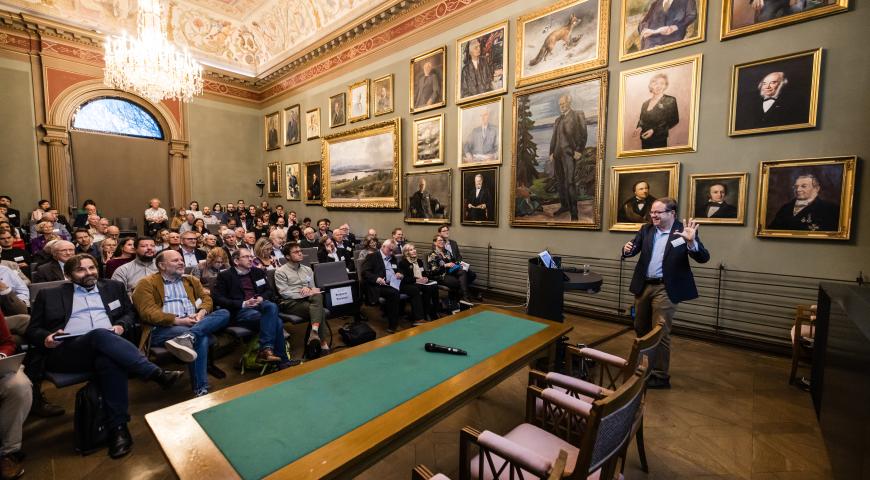
Time: 5 November, 08:45–16:00
Place: The Norwegian Academy of Science and Letters, Drammensveien 78, 0271 Oslo
Register: https://dnva.pameldingssystem.no/international-vista-seminar
The energy transition is no longer only about technology. It is about choices: where our energy should come from, who should bear the costs, and how we balance climate ambitions, economic development, nature and local interests. As energy becomes an increasingly decisive economic and political issue, finding solutions that are both effective and broadly accepted is more important than ever.
Our societies need more clean energy to decarbonise their economies. At the same time, producing and transmitting that energy can have significant impacts on nature and local communities. The benefits and costs of the transition are unevenly distributed, while high and volatile energy prices have brought energy policy directly into households, businesses and political debate.
This year’s VISTA Day brings together researchers, policymakers and other key actors to explore these dilemmas – and to discuss how we can create an energy transition that works in practice.
The day opens with a keynote by renowned researcher Professor Johan Schot, who will explore how systems change in times of disruption. From there, we turn to the potential for change from the bottom up: How can citizens, communities and small businesses become active drivers of the energy transition rather than simply adapting to decisions made elsewhere?
We then shift perspective from the local to the political. With contributions from the Norwegian and European levels, we ask how governments and institutions can provide stable and predictable frameworks for change – while navigating competing economic, environmental and social interests.
After a cultural energizer, we turn to one of the most immediate and politically charged questions in today’s energy debate: energy prices. What are the political, economic and market effects of instruments such as “Norgespris” – fixed electricity prices for Norwegian households – and other forms of energy subsidies? Who benefits, who pays, and what are the longer-term consequences?
VISTA Day is designed not only as a forum for presentations, but as a meeting place for discussion and dialogue. Throughout the day, participants will have the opportunity to engage with researchers, policymakers and other actors shaping the energy transition – and to explore the difficult choices that will determine how we move forward.
The VISTA Day is part of the VISTA Week 2026, 2–6 November.
Programme
08:45 – 09:15 Registration
09:15 – 09:30 Welcome
Lise Øvreås, Chair of the VISTA Board; Christian Klöckner, Centre Director, NOTRAP; and host Stein Mortensholm
09:30 – 10:00 Keynote: Are major disruptions of the energy system a chance for system change?
Johan Schot, Utrecht University
10:00 – 11:00 Bottom-up energy transition: What do energy systems designed by citizens look like?
- Johan Schot, Utrecht University
- Anna Wieczorek, Eindhoven University of Technology
- Marianne Ryghaug, SINTEF
- Espen Hatlinghus, Hatlinghus AS
11:00 – 11:30 Break and mingling
11:30 – 12:30 Top-down energy transition: Political consensus-building around energy policy
- Eero Ailio, Adviser, Energy Transition & Local Governance, DG Energy, European Commission
- Nikolai Astrup, Member of the Storting (Conservative Party)
- Magdalini Christofi, European University Cyprus; Young EU Energy Ambassador
12:30 – 13:30 Lunch
13:30 – 14:00 An artist’s perspective on the energy transition: music and reflections
Marte Wulff
14:00 – 15:00 How to handle high energy prices politically?
- The Austrian “climate bonus”: how it worked, its effects, and why it was stopped: Margit Schratzenstaller, Austrian Institute of Economic Research (WIFO)
- “Norgespris” and other models in the Norwegian electricity market: Diderik Lund, University of Oslo
- Panel debate with researchers and politicians
15:00 – 15:30 Break and mingling
15:30 – 16:00 Wrapping up: Where do we go from here?
Panel discussion
16:00 Buffet and mingling