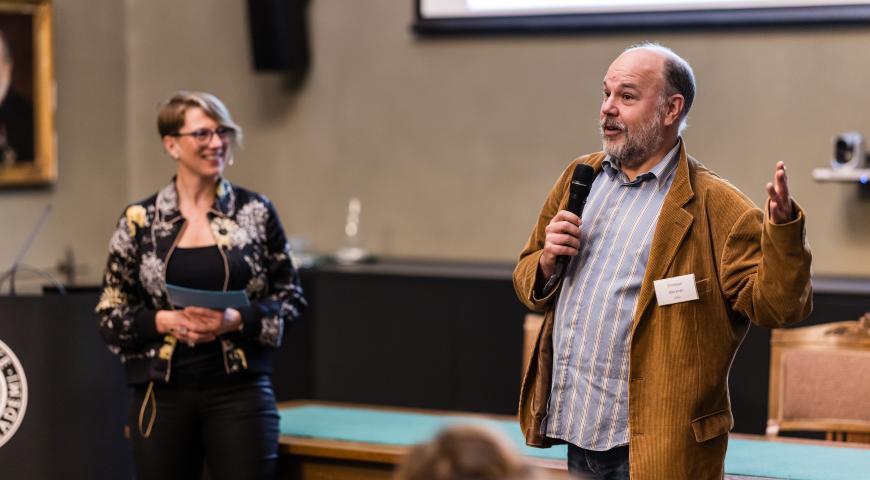
For the second year in a row, the VISTA Week brings together school pupils, municipalities, researchers and policymakers at the Norwegian Academy of Science and Letters. The week takes place 2–6 November.
The VISTA Week opens on Monday 2 November with a school day for upper secondary pupils, organised by the VISTA centre VICCO at the University of Oslo together with the Department of Geosciences. Pupils from Foss videregående skole and Oslo katedralskole will hear researchers from the University of Oslo and the Norwegian Water Resources and Energy Directorate (NVE) talk about CO₂ storage in rock, critical minerals and the physics of large landslides. In the afternoon, they will build and test their own seismometers, study minerals under the microscope and present what they have found.
See the full programme (in Norwegian)
On Tuesday 3 November, the focus shifts to Norwegian municipalities and county councils. Energy has become a pressing local issue: how to meet future demand, whether to say yes to data centres, how to bring energy into land-use planning, and what to give up along the way. The Municipality Day is a meeting place for planners, advisers and managers in the municipal sector to share what works and what doesn’t. In the afternoon, NOTRAP and Hitra Municipality present the first Energy Policy Incubator, a method for developing local energy transition pathways together with stakeholders.
See the full programme (in Norwegian)
Testing a new tool for local energy transitions
On Wednesday 4 November, the VISTA Think Tank takes a closer look at the Energy Policy Incubator concept. Over the past year, NOTRAP has developed the incubator as a tool to help municipalities handle conflict-laden transition processes in a fairer way. National and international experts will test, discuss and refine the concept. Members of NOTRAP’s Scientific Advisory Board, from the University of Lisbon, Joanneum Research and the United States, will contribute short inputs from their own work.
Energy transition bottom-up and top-down in a chaotic world
On Thursday 5 November, the International VISTA Day asks how the energy transition can be both effective and broadly accepted when costs and benefits are unevenly distributed. Professor Johan Schot (Utrecht University) opens with a keynote on whether major disruptions of the energy system can be a chance for system change.
The day then moves from the local to the political level:
- how citizens, communities and small businesses can drive change from the bottom up;
- how governments and institutions at Norwegian and European level can build political consensus around energy policy.
The afternoon turns to energy prices. Researchers from the Austrian Institute of Economic Research and the University of Oslo will discuss the Austrian “climate bonus”, the Norwegian “Norgespris” and other models.
Speakers include researchers from Eindhoven University of Technology, SINTEF and the European University Cyprus, as well as representatives from the European Commission and the Storting. The musician Marte Wulff will offer an artist’s perspective on the energy transition.
The VISTA Week concludes on Friday 6 November with the VISTA Researcher Day, a workshop for researchers and PhD candidates at the four VISTA centres. This year’s theme is how to work across disciplines. The day is run by VICCO and opens with a keynote by Anja Røyne (University of Oslo) on communication across disciplinary boundaries. Participants will then present their own research in poster sessions, looking for new connections and ideas for collaboration.